Teams inside established companies
New line: the next 5 to 7 reference customers
It doesn’t have to be a startup. It can be a small team within a larger company: a new product line, an innovation team, a venture the owner set up. If the new line has its first 2 or 3 paying customers and a review date on the calendar, this page was written for you.
Someone else funds the work? Send this page to your sponsor: two minutes on what they see, what your team keeps and how buying works.
The situation: a new line, a budget calendar
The first 2 or 3 customers came through people who already knew the company, often through one account manager. Your sponsor asks what every funder asks, “is there a business here?”, and the answer comes due on a date the budget calendar set.
Your company holds years of customer records: support tickets, survey comments, Net Promoter Score results, sales notes, renewal histories. Nobody gathered any of it to answer that question. The sales team owns the relationships the new line needs, and carries a quota for the current products. Anything public carries the company’s name, so every test goes through the brand team first.
You, your sponsor and the sales team share that situation.
Three advantages inside a company
My 2018 talk on being an intrapreneur named them on slides 17, 43 and 58, and I think it’s even more salient now:
1. Real paying customers. The existing customer data, customer touch points and customer insights can now be mined on a continuous basis with artificial intelligence (AI), inside your company’s data policy. This month: find the existing customers who face the situation the new line solves, and who owns each account.
2. A business model you understand. Write the new line’s value hypothesis and growth hypothesis in plain words, then test the riskiest assumption first. This month: list every assumption the new line depends on, and score each one.
3. A network of untapped resources. Account managers, partners, distributors, the trade shows your company already attends, its newsletter, its experts. This month: rank which channels to test first, and brief the account owners who will make the introductions.
None of the 3 proves demand for the new line on its own. Each becomes an assumption to test: “customers who buy our current line will buy the new one”. The full argument, slide by slide.
The method, run inside a company
I put it this way to a class in 2020: “you don’t have to guess, you don’t have to be right, you don’t have to make it up, you simply have to go uncover it.”
- Customer words first. Your company’s own records, plus 2 or 3 interviews with the new line’s first customers, coded into 4 forces: push, pull, habit and anxiety.
- The assumption portfolio. Every assumption scored 1 to 5 on the chance it’s wrong and 1 to 5 on the damage if it is, multiplied, and the top 3 tested first.
- The basics, through your approvals. A page, short videos from you as the team lead, and the first case studies, cleared by your brand team.
- Two-week tests. Channel tests start in existing accounts with the account owner in the loop, then move to strangers.
Your team owns product-market fit, and every result goes into the product roadmap. The method in full.
The board: a sponsor’s ten-minute review
By June 2016 at Medlantis we kept the whole plan on one board: the customer, the problem in their words, what we’d build, the assumption that would sink it, a test with a pass mark set before we ran it, the result, and whether we pivoted or persevered. The first row needed 7 of 10 medical device sales reps to get through our courses. None did, so we pivoted. Further down the board, 45 of 50 doctors used a working prototype. A demo at a medical society meeting produced 7 leads against a pass mark of 5, and one buyer paid more than $10,000 (in United States dollars) on the spot.
I presented that board to our chief executive and our board of directors. As I told it in a November 2020 talk: “in 10 minutes I walked my board of directors through this and they went, wow, this is really, really, really powerful.” And: “I can stand in front of a board of directors and look them straight in the eye when they ask, you know, can you take on our next goal? And you’re like, yes, I can.”
Inside a company the same board doubles as your review artefact, updated at the end of every 2-week sprint. Those are the “little tests that give you the right to do the bigger investments”.
Existing accounts, through their owners
Your sales team joins the plan in sprint 1, as the people who introduce the new line to their accounts, with the credit for each introduction. Nothing goes around them.
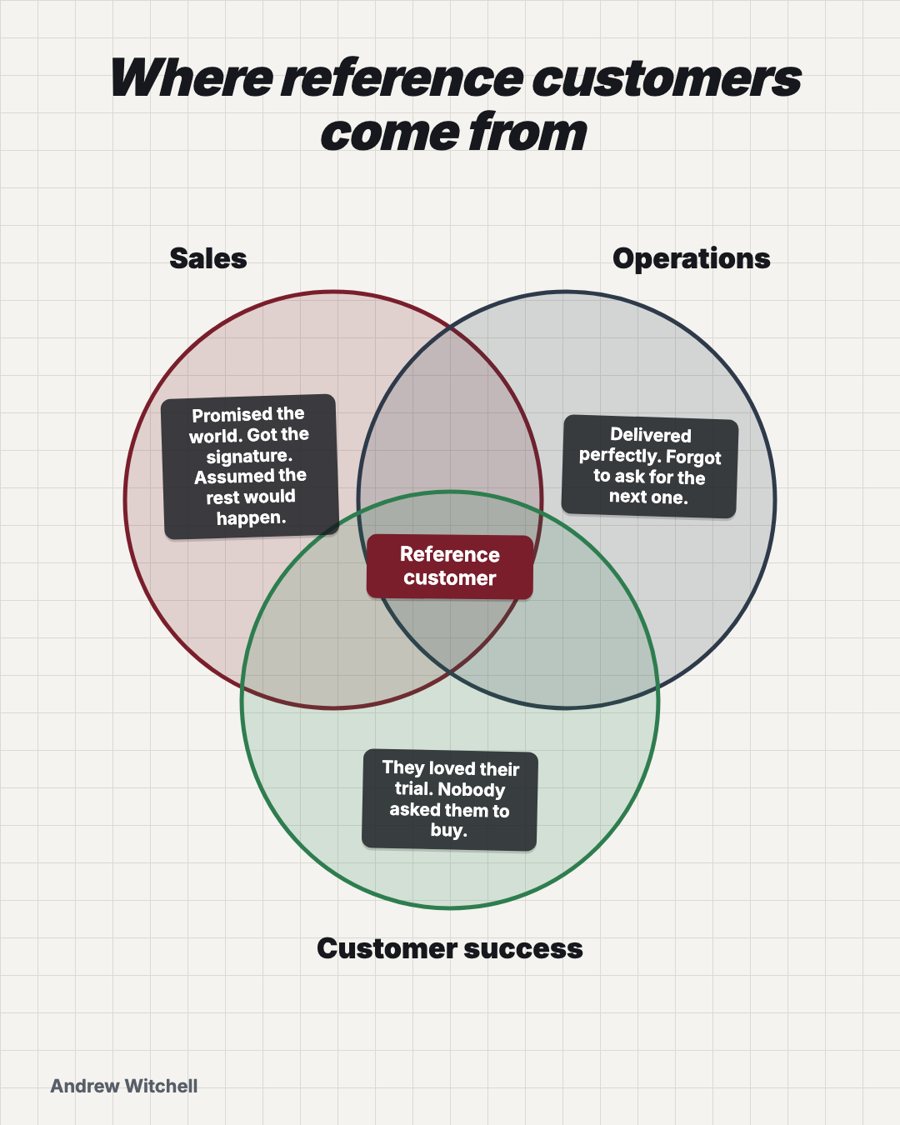
A reference customer comes from where sales, operations and customer success meet. Sales wins them, operations delivers what sales promised, and customer success keeps them happy to take the call. Inside a company those 3 often report to different leaders, so the plan names who does each.
The usual answer to a slow pipeline is volume: send out 10,000 emails to get 3 conversations. In your company’s own accounts that spends relationships your sales team took years to build.
My record on internal innovation teams
- I’ve been part of many internal innovation teams.
- At Medlantis, as chief operating officer, we grew from 12 hospitals to 143 in 3 years.
- I designed the customer-facing scoping and pricing process Majesco used to bid multi-million-dollar proposals.
- At ProServeIT I co-led the launch of the project management office, and ran a seven-figure portfolio of 15 to 20 client projects at a time.
- At Insight Medbotics I reported weekly to the chief executive, the board and shareholders.
More on my record.
Fit: a new line with paying customers
It fits a team lead whose new line has its first 2 or 3 paying customers, paid pilots included, with a sponsor who has asked for speed. It fits the owner who funds an internal innovation team, too.
No paying customer for the new line yet? Start with the three advantages and the free kit, built for that stage. Want someone to run the programme for your team? The kit again: here your team does the work and keeps it. Founded your own company? The homepage speaks to you. A medical device line still waiting for clearance? The rules on promotion before clearance apply in full, so start with the page for medical device companies.
Tell me your origin story
We book 1 to 2 hours, with a mutual non-disclosure agreement (NDA) in place at booking, so you can talk openly about the new line, its first customers, the review date and who has to say yes. It costs $25, basically enough to cover the tokens to analyze our call and build out your report. Within 24 hours you get a written playbook, broken into steps your team can actually take. If the session isn’t worth your hour, I’ll refund double: $50.
Two things work differently for a team inside a company. If you can’t bind your employer to an agreement, email me before you book and I’ll sign your company’s own mutual NDA, or we keep the first hour to what you’re free to share. I normally record the session; if your company’s policy rules out recording a supplier call, say so when you book and I’ll build your playbook from my notes.
Questions first, or your company’s NDA to send: andrew@loopgrow.co. For the person who funds the work: the page for your sponsor.